Site
Market Place
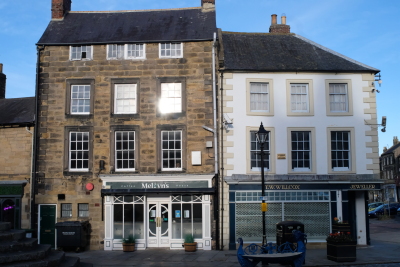
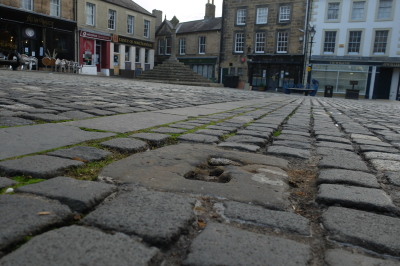
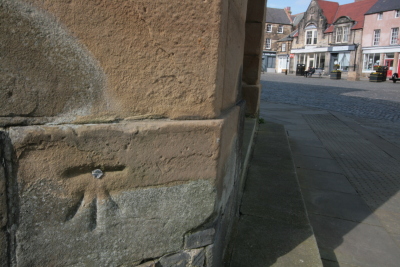
Tate: Market Place - called Market Stede in 1569 - is nearly in the centre of the town and was originally a noble square but is now darkened by a large modern building called the Assembly Rooms. The Market Cross, a poor structure, having a shaft surmounted by a ball and resting on a flight of eight stone steps is in the north-east corner ; and on the west side are the Town Hall and clock. A house on the north side was before the Reformation used as a chapel.
"Alnwick Market Place is a legible space located within the town‟s historic core. The surrounding buildings are rich in architectural quality; particularly the Grade 1 listed Northumberland Hall constructed in 1826 with its arcaded ground floor. Major resurfacing of the Market Place and adjacent streets, together with removal of car parking began in the late 1990s courtesy of European Regional Development Fund and Heritage Lottery investment".
---------
We cannot be certain when Alnwick emerged as a settlement. There are several possibilities, but the road junction at Bailey’s Corner is thought to be older than the settlement. The most likely origin of Alnwick is that people started to settle around this junction in Anglo-Saxon times, and a village formed around a triangular village green that is still marked by road layout of Bondgate, Market Street and Fenkle Street. Villages form like that to protect livestock from wild beasts and raiding parties.
Once the Normans had chosen Alnwick as an important centre for defence of the border the town gradually grew in importance. Military activity was based around the Castle and Bailiffgate while commercial activity was concentrated on the marketplace. Medieval charters refer to trading in a wide range of commodities including corn, livestock, skins, textiles, raw materials for tanning and dyeing, timber and construction materials, as well as a variety of provisions and merchandise. The early market would have occupied the whole of the central triangle, and there were no other streets in the centre of town, apart from two lanes: one leading to the Green Well and the other to the Stone Well.
By the time of Queen Elizabeth I the large central triangular green was beginning to fill with permanent buildings. A survey of 1567 shows it occupied by a number of houses, shops, a smithy, beer house, bakehouse and a former chapel. It prably wan’t much later that the butchers’ shambles originated. They were rebuilt in 1764, then again in 1826 as the Assembly Rooms (now Northumberland Hall). But by then, the present rectangular marketplace was already well-established by gradual encroachment of permanent buildings onto the original triangular green.