Site
Correction House Lane
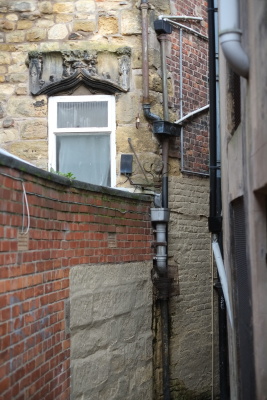
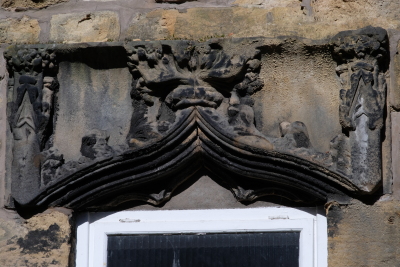
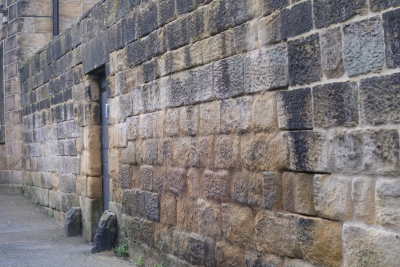
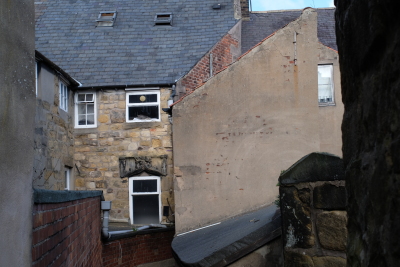
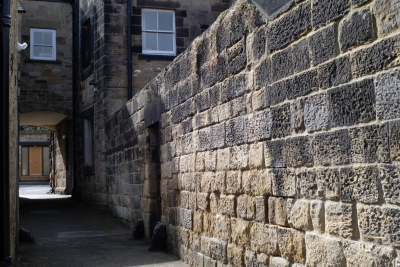
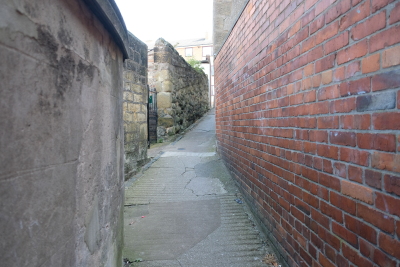
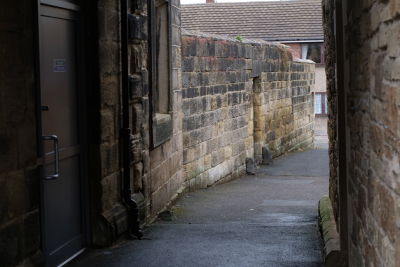
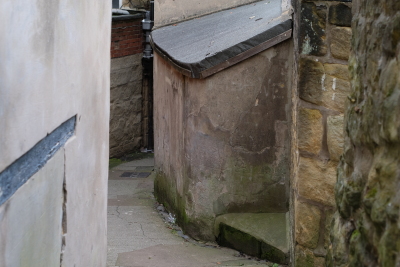
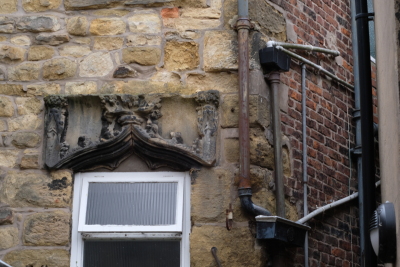
The lane, ruminating today with its head end between St Michael's Square and Market Street and the remnant of its tail end from the Square to Green Batt, follows the line of an ancient burgage strip plot with the head end facing the Horse Market. What is now the Copperfield Restaurant would have been a shop with residence above and workshop behind. A four-foot wide archway gave access to the buildings and facilities behind, built within the confines of the narrow strip, e.g. a yard, a pig-sty, a hen run and garth (garden). The Lane originally ended at Green Batt (which would then have been common grazing land), but since 1960 it has been interrupted by the construction of St Michael's Square. It is indicated on maps prior to 1774, and is clearly shown on maps from 1827 and 1851 in Prof Conzen's Alnwick Town Plan Analysis published in 1967. A Correction House was built near the tail end, extending over two burgage strip widths - about 601E°: - in 1807. There were nine cells, a workroom for picking oakum and other punishment tasks, two yards (one for each sex) and a large court room where the magistrates met every two weeks. The penal complex is shown in some detail in the 1866 OS Map. The alternative name for the Lane, Kitty, was North Country slang for a jail, prison or House of Correction. On the east side of the tail end a workhouse was built across two burgage strips in 1810, faced with plain ashlar stone, with evidence of an archway where the second burgage strip would have been. A new workhouse replaced it in Wagonway Road in 1841 and is now used as the Council's Rating Office.
In 1856 a more imposing Courthouse was built to replace theWesleyan Chapel, facing onto Green Batt in front of the Correction House. The local ashlar stone and the treatment of windows and doors suggest a Georgian
influence. The Correction Lane Courthouse and Workhouse buildings are now used by Northumberland County Council. Most of the burgage strips became grossly overcrowded by the end of the 19th Century, because little building had taken place beyond the line of the 15th Century Town Al.This overcrowding resulted in severe slum
conditions with inadequate water and sewerage, a situation which still existed in Correction House Lane until as late as 1947. The author of this survey recalls being called at about that time, as a young doctor, to a home confinement in a very poor house without water or sanitation in Correction House Lane. The worst dwellings were gradually removed from that date until St Michael's Square was developed, leaving only the head end of the Lane and a narrow footpath at the tail end intact.