Site
Former Sion Meeting House
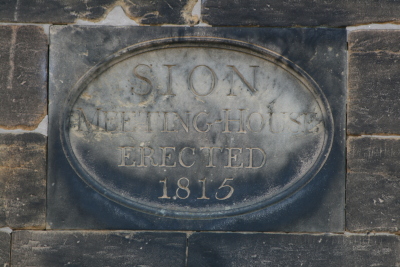
ST MICHAEL'S LME 1. 5330 (West Side) Former Sion Meeting House NU 1813 SE 1/109 II GV 2. Dated 1815, Two storeys, 4 windows with 2 storeys, one window wing to right and single storey, 2 window wing to left. Ashlar with eaves band. Hipped slate roof. Segmental headed windows with late 2 light 'Y' glazing. Only one original window with 'Gothick' glazing (in right hand wing on 1st floor); the rest have sub-art nouveau style coloured glass. Two doors, one in each wing with later ledged doors having heavy hinges and depressed arch light above. Oval panel with "Sion Meeting House Erected 1815" in centre of main part. Now a warehouse.
-----------------
Tate:
The meeting house in Bondgate being in bad repair, it was sold ; a site for a new one in St. Michael’s lane was purchased; and a place of worship called Sion Chapel was erected, containing about 700 sittings, and having a clumsy gallery around three sides of the building. It was opened on June the 30th, 1816, by religious services, which were conducted by the Rev. Edward Parsons, of the Independent chapel, Leeds, and the Rev. William Vint, theological tutor of the Independent college, Idle. The site and building cost £1972 ; by the sale of the old meeting house, by subscriptions of the members, and collections from other congregations, £1550 were raised, leaving a deficiency of £422; but, such has been the liberality of this congregation, that the whole of this debt was gradually paid off, and totally extinguished in 1849.
In the trust deed, dated August 3¥st, 1815, Ralph Annett sells to the elders. and members of this society of protestant dissenters, for £150, that picce of ground behind a messuage of Ralph Annett in the Market Place, upon trust,. to permit a mecting house, &c., to be built and occupied as and for a place of religious worship by the society of protestant disesenters usually assembling at Bondgate meeting house; and permit elders, nominated by the men subscribers to the said meeting house, or the major part of them, being members of the said society and communicants therein, at any meeting for that purpose assembled, to receive voluntary subscriptions towards the support of the public worship, or support of the minister for the time peing officiating ; and permit to officiate such minister as the major part of the subscribers, men or ‘women, being members of the society and communicants therein, at a meeting
duly assembled for that purpose, shall from time to time elect, to officiate as their minister or pastor in the said meeting house, according to the usual order and customs of the societics of protestant dissenters. Power is given to the trustees, by the authority of the majority of male members at a meeting, to mortgage, sell, or exchange the property, and invest the money for the benefit of the society ; and if the society is totally dissolved or dispersed, and public worship discontinued for two years, the trustees may dispose of the premises for such purposes, either religious or civil, as two-thirds of the members, who have been subscribers for one year, shall appoint in writing. When the trustecs are reduced to five, the vacancies shall be supplied, to make the number twelve, of so many protcatant dissonters by profession; such appointment being made by a majority ef men subscribing members or communicants; and of such meetings notice is to be given after divine servico’; but they are not to be beld earlier than the Wednesday after such notice.—L£nrolled in Chancery, 29th April, 1862.
As Mr. Rate advanced in years, he lost his early fervid dissenting spirit, and developed strong proclivities towards established churches. Unfortunately for the congregation he endeavoured to change its character and link it with the church of Scotland; and by what were deemed unfair and irregular means he succeeded in procuring the appointment of Thomas Dewar, a licentiate of that church, as his assistant and successor. Dewar’s call was signed by only 146 persons; and so unpopular was the appointment, that his ordination instead of being made, as is usual, in the presence of the congregation, took place at Edinburgh before a few Scottish kirk ministers. By such arbitrary proceedings the peace of the congregation was broken and a fierce controversy raged ; pamphlets appeared on both sides, as well as some curious descriptions of the scenes acted within the chapel during the struggle. Two able pamphlets written by the late Ralph Morton, one of the most earnest and intelligent of the members, are of value for historical notices of the congregation.
Many members were driven from the body at this crisis. The Rev. Thomas Dewar entered on his duties on May 18th, 1839, but he resigned on August 30th, 1843, on being appointed minister of the south church of Aberdeen.
Freed, by this time, from the influence of priestly dictation, the congregation, in accordance with their principles, elected as their minister, on November 12th, 1843, George Richards, a student of the Independent college of Airedale. The Rev. Joseph Rate resigned, on January 7th, 1844, the pastoral charge of the church, which he had held during forty-three years ; and he died on December 5th, 1846, aged 70 years.
The Rev. George Richards continued minister till November Ist, 1849, when he accepted acall from a congregation in Howden, Yorkshire. The Rev. Robert Greener became pastor on February 10th, 1850, aud laboured diligently as a faithful minister till his death, on January 8th, 1865, in the forty-first year of his age. He was greatly esteemed as an amiable, good man, and as an able preacher ; for his sermons .
were distinguished by originality of thought, and beauty of style. The present minister, the Rev. J. T. Shawcross, of Burnley, who had been educated at Airedale college, having been unanimously called, became pastor of this church on October 15th, 1865.
A return made to the churchwardens in 1829 states, that there were then 838 persons belonging to the congregation ; and according to the registrar-general’s report, there were on March 30th, 1851, present at the morning service in the chapel 278, and at the evening service 132; the average attendance during the preceding twelve months being in the morning 300, and in the evening 200, and the total number of persons belonging to the congregation 518. . The baptismal register commences February 17th, 1762; but there were earlier records from 1781 to 1762, which were lost many years ago.
Though not numerous, the members of this church have been remarkably liberal in the support of religion. Besides contributions to missionary and benevolent societies, and keeping up the fabric of their chapel, and providing for the celebration of praise by an organ and choir, and paying other incidental expenses, they give to the minister £170 yearly.
During the year 1866 the chapel was considerably altered and improved ; the whole of the interior was remodelled, the clumsy gallery taken away and a smaller one placed in the south end; the pulpit has been removed to near the north end, and a gallery for the organ and choir placed behind it. These alterations cost about £500. A house, too, has been bought as a residence for the minister, costing with alterations above £600. Such is the power of voluntaryism, where religious privileges are valued.