Site
Former Correction House Yard
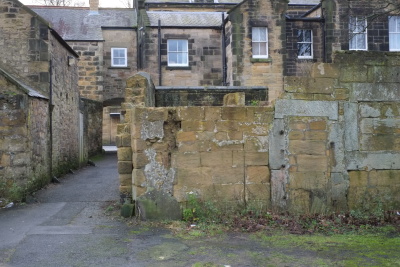
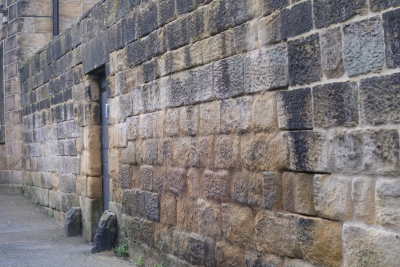
1/264 GREEN BATT 1. 5330 (North Side) Former Correction House Yard at rear of No 34 NU 1813 SE 1/264 II 2. To rear are considerable portions of the old Correction House Exercise Yard circa 1807. Three blocked windows with raised dressings on ashlar north wall and a doorway with bolt-slides at rear. An old washing trough near wall.
Report of visit by commisoners in 1809:
This Prison, first inhabited in October, 1807, has, on the ground-floor, two of the Keeper's rooms in front. These are divided by a passage 4 feet 6 inches wide, leading to the Gaol door, and entrance into. a lobby '24 feet long, and 4 feet 6 inches wide ; with an iron-grated and glazed casement at the end of it, IQ inches by 16 ; and into this lobby five sleeping-cells open. The smallest cell is 9 feet 5 by 7 feet 8, and 8 feet 4 indies high to the crown of the arch ; the whole of stone, fitted up with wooden bedsteads for two persons, loose straw, two blankets, and a coverlet : a small uncovered tub for a sewer, emptied every morning ; and a wooden stool to sit on. Every cell-door has an inspecting wicket 8i inches square. On the North side is a court-yard for Men, who are allowed to be out for one hour in the day, accompanied by the Keeper : It is 42 feet square, and, in the centre, has a sewer, and a pig-stye ; and part of it is planted with cabbages. The Women's court is on the South. -side, 63 feet by 3G, with a detached sewer in it. The area forms the Keeper's garden, and is planted with vegetables. Females have the use of this garden one hour in the day. Above stairs are three sleeping-cells for Women, of the same size with those below, and opening into a lobby of like dimensions. Their cells contain two wooden bedsteads for two persons each, and are fitted up like those assigned for the men. There is also a lai^e work-room on this floor, of 22 feet by 12, witli two large grated and glazed lift-up sash windows, and a large fire-place ; for which coals are allowed during the six winter months. For the rest of the year the pri- soners work in their sleeping-cells, which, having no grate, are frequently very cold.
The Magistrates hold their Petty Sessions every fortnight in a convenient room above stairs. No rules, however, or regulations are printed and stuck up. Here are no rooms set apart for the sick : No day-room allotted : No bath or oven to purify foul or infected clothes : No water accessible : even the Keeper, for his own use, fetches it from a pump 300 yards distant! The Act for preserving the Health of Prisoners, and Clauses against Spirituous Liquors, are not hung up. The employment of the Prisoners consists in beating hemp, picking oakum, winding cotton, cutting candle-wicks, spinning and knotting of rope. The average of earnings is 3«?. per day, which the Keeper has, in aid of maintenance. The Prisoners have no share ; neither do they receive any money on being discharged, to carry them home, or prevent those necessities, which may impel them to predatory acts, when happily liberated from a gaol.
Alnwick House of Correction was built in 1807, with a work room, nine cells and two exercise yards (one for men and one for women). There was also a room for Justices of the Peace, who met there every couple of weeks. The Court House was added in 1856, on a site that had been a Wesleyan Chapel, then a candle factory, fronting on to Greenbat. The building later became a police station, and is now a Youth Hostel.
150 years ago this was one of the most expensive prisons in England.
From the Alnwick Mercury, Jan 1870:
…the Saturday Review of last week makes the following startling statement: the average charge for each prisoner is £37 a year. The county prisons of Alnwick and Oakham show a large excess above the average, the cost of a prisoner at the one being £82 and the other £93 a year. It is not stated whether these costly inmates are nourished on game, poultry, and pudding throughout the year; nor whether crime is checked in Northumberland by a luxurious prison diet”
The diet was not luxurious. At a weekly cost of 2s 4d per head, prisoners in Alnwick were given:
| Male | Female | |
| Bread | 4lb. 1oz. | 2lb. ½oz. |
| Meat | 3oz. | 3oz. |
| Porridge | 14 pints | 14 pints |
| Potatoes | 2lbs. 11oz. | 2lbs. 11oz. |
| Soup | 1 pint. | 1 pint |
| Treacle in porridge | 22 ozs. | 22 ozs. |
| Suet pudding | 1 lb. | 1 lb. |
The reason Alnwick House of Correction was relatively expensive was that there were not many prisoners. Fifty years earlier, over 200 prisoners a year were being committed to Alnwick House of Correction. Although it sometimes held no prisoners, it commonly held around six, and at one point thirty. But a new gaol opened in Morpeth in 1828, Tynemouth House of Correction was extended in the 1830’s. By 1838 the prison inspector reported ten prisons in Northumberland, including small lock-ups at Rothbury and Belford. By the middle of the 19th century only around 50 prisoners a year were sent here, and the number held was normally one or two.
By 1870 the cost of maintaining the building, and paying a keeper and matron was disproportionate. It closed as a prison in 1871, though the cells continued to be used by the police. A number of smaller prisons were closing around this time That wasn’t just because of the high costs – it was also becoming difficult to recruit suitable staff.
The present keeper has held his situation about 18 months, and was before that time chief officer of the Alnwick police. He is 32 years old. His salary is £54 per annum with a free house. He appears in some respects to be well qualified for his situation, but his want of the habit of speaking the truth on all occasions is a very serious defect.