Site
Site of Wythop Mill
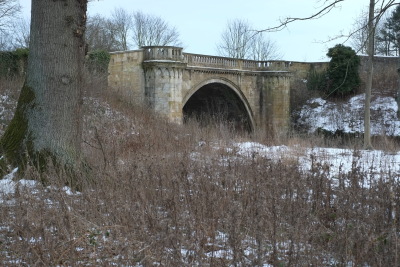
From about 1770 to 1839 there stood on the north side of the Aln, and a little to the west of the present Denwick bridge, a very picturesque mill known as Wythope Mill. An engraving of it which I possess shows it to have been a structure of considerable architectural beauty, and it would form a pleasing and prominent object in that beautiful wood and water prospect which unfolds ite beauties from Denwick bridge to the highest summit of the moor, George Tate writes thus of it in his History of Alnwick, Vol. I, p. 461 :— ‘“ It was a picturesque object seen from Denwick Bridge, and its removal in 1839 was regretted by many who had often lingered on the bridge, listening to its clack and enjoying one of the flnest views of the Castle and of vale of the Aln.” Strange to say, although this mill served a useful purpose, was probably a good living for a family, and was moreover an ornament to the landscape, it was ruthlessly swept away in 1839, through some fad, whim, or prejudice, call it what you will, of the Castle authorities
(Letter to Alnwick Guardian and County Advertiser 3 Aug 1895)
OLD WATERMILLS
Perhaps the following particulars on this subject may interest your correspondent, Mr. J. Manley, Newcastle. Following the course of the Aln from the sea we have first to notice, Lesbury Mills, with which, as Mr. Horsley stated, the family of Thew, of Shortridge and Alnwick, have long been associated. Several presentments were made at the baronial Courts of the Earl of Northumberland during the seventeenth century, against persons for taking their corn away from this mill and having it ground elsewhere. Ascending the river we arrive at Denwick Mill sometimes called the " Flint Mill " probably from its mill-stones —and " Eadington's Mill"). — This mill stands at this southern end of the Cowslip Hills, on the north bank of the river, and opposite the Lough House. It was once.. the Denwick Fulling Mill, and was converted, a little over half a century ago, into a corn mill by Mr. Peter Eadington, the descendant of an ancient race of millers. It is at the present time in the occupation of the family of Eadington. On the opposite side of the river there is the farm of Bog Mill, named from a mill which once stood on the Bog. the property of the Corporation of Alnwick. This mill was taken down in 1804. During the seventeenth century a mill stood a little higher up the river at a place called Hesleyside. Ascending a little further we had Wythope Mill at the east end of the North Demesne, or " Pasture," and close to Demwick Bridge. About 1770 this mill was rebuilt to an imitative Gothic style. This building was a picturesque object from the Denwick Bridge: it was pulled down in 1835. Some years ago I saw a pictire of t in London painted by a talented local artists- name Mr T Potts, a Scotchman who reside in Canongate, Alnwick, about the beginning of the promat century. but afterwards removed to Newcastle. One of the finest views of Alnwick Castle and the vale of the Aln is to be obtained from near Denwick Bridge: the picture referred to embraced this exquisite piece of landscape with the castle in the background and I am under the impression that the mill formed a prominent feature in foreground. At the time when his Grace Algernon, Duke of Northumberland was taking great interest in the breeding of salmon and having fish ladders placed in the river, the old ''mill race" was converted into a salmon run, with ladders for the fish to ascend, under the supervision of the late Mr. Frank Buckland. Two high waterfalls—one below the bridge and one above it at site of the old mill—prevented the salmon during the spawning season from ascending and reaching the higher parts of thin river to deposit their spawn. The water flows into the "race" just above the waterfall, said reaches the river just underneath the lower one. Previously the water had not been allowed to enter the disused "race." After Wythope Mill was rebuilt it was best knows as "Eadington's Mill," from being in the occupation of that family. The lane leading from Bondgate Street Without, at the southern entrance to the town of iloinek, to We pretty little village of Denwick is called the "Mill Lane." Two mills formerly existed at the west end of the "Pasture" near the Lion Bridge. One stood eastward of the bridge, called the "Grey" or Low Mill," and the "Blue Stone Mill" (from the, colour of its millstones); the other westward, and was called the "Wheat "or "High Mill." During this seventeenth century these mills were in the occupation of the Corporation of Alnwick as tenants of the Earl Northumberland, and hence were called the "Town's Mills." A piece of land lying at the foot of Barbara's Banks, and now forming part of the Duke's private grounds, is still celled the " Miller's Haugh," sad was at one period attached to the "West Mill" This mill was carried away by a flood in 1767, and was rebuilt' but it suffered a similar fate in 1770. After this, the mill and cottages were removed from the river side. The next to receive our attention are the Alnwick Abbey Mills, which stand on the west side of Canongate Bridge. Them are still in ' going order." I have no doubt that visitors to the Alnwick Horticultural and Botanical Exhibition, and the Northumberland Agricultural Show, which are held in Hulne Parks beyond the bridge, are year by year struck with the picturesqeness and beauty of this locality. From Canongate Bridge a splendid view is obtained at the mill, the waterfall. the Abbey gateway. and the woods forming the background of this little bit of scenery. These mills belonged to the Abbey in the days of its prosperity ; but after the Dissolution they changed hands several times. They were in the hands of Queen Elizabeth afterwards in the possession of the Brandling family and were sometimes called " Brandling's Mills." During the greater part of the lest century they have been successively occupied by Mr. Dixon, Mr. William J. Wilkinson (a descendant of the Wilkinsons of Buston), Mr. Dixon, who came from Edinburgh, and Mr. Thomas Lough has continued to carryo the business. In our course we now enter Hulme Park through which the Aln flows and we find that Hulne Abbey had its mill sitauted on the banks of the river at the foot of its eminence on which that religious hose stands. After leaving the Parks, we shortly reach Abberwick Mill, with which the name of Shell has long been associated. Higher up, we come upon Bolton Mill. There is a mill at Eglingham, by the side of a small rivulet, which afterwards falls into the Aln. During recent years this has been converted into a steam mill, for when passing it a few years ago I heard the noise from the engines. There is a mill at Shipley, which. I believe, is situated on the banks of the same stream just previous to its reaching the Aln. Longhoughton is some distance from the Ala ; and the mill at that place, when in working order, must have received its motive power from one of the "burns" which flow pest the village. Two or three weeks ago, I walked along the sands from Alnmouth to Boulmore —Longhoughon lies about twc miles west of the latter place—and I noticed that two small rivulets fell into the sea from the Longhoughton district between the sea side villages I have mentikoned. Boulmer is about four miles by the seaside route from Alninouth ; and I think Longboughton is about the same distance from the Aln When on a visit to Bambrough some years, ago I rambled along the shore north of the castle towards Budle Bay, when I came across a stream running into the sea—the Waren, if I remember rightly and a short distance inland some buildings were pointed out to me as Waren Mills, with which the family of Nairn have for a very long period been connected.
Letter from Robert Dunn to Newcvastle Chronicle, 3 October 1885