Site
Hulne Park Wall
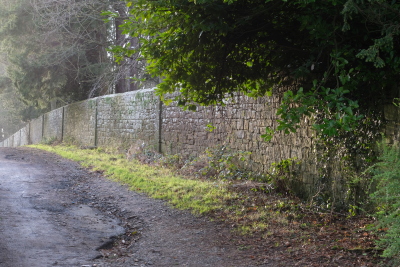
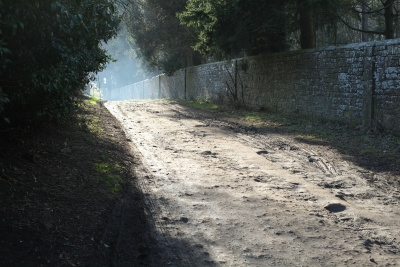
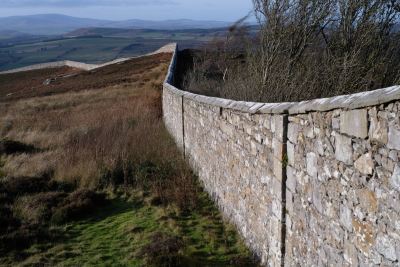
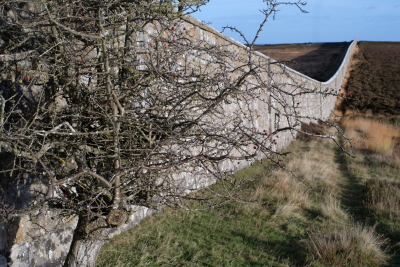
In 1513 Hulne Park was enclosed by a stone wall, said to be twenty miles long (but probably less). Hulne Park was described as well replenished
with fallow deer, and well set with underwoods for cover and preservation of the deer. “a very stately park-like ground”. Part of the pale of the Hulne deer park can still be seen as a ditch and bank near Cloudy Crags, crossing the 19th century wall at an angle.
By the 1530s the number of deer in Hulne Park and West Park had fallen from 824 to 160 but Hulne Park and West Park were still partly protected
by a wall and partly by a pale. Cawledge was protected by a pale but all were described as very decayed. Then a survey in 1570 found both Hulne Park and West park “for the most part enclosed with a stone wall”.
When the second duke took over in 1786 the condition of the boundary must have deteriorated. Tenants had been responsible for taking care of it, but there is little evidence that they did. By now deer parks were falling into disuse, and the land was taking on a more economic role.
The ninth Earl was suspected of having some involvement in the gunpowder plot, and was confined to the Tower of London and fined. He needed to raise money so he commissioned Francis Mayson and Robert Norton to survey his properties. Their maps show both Hulne Park and
Cawledge Park surrounded by wooden paling.
Sir Hugh Smithson and Elizabeth Seymour inherited her father’s estate in 1750. The new Earl wouldn't become Duke until 1766, but he already brought experience of managing large estates, and political skill. Restoring the castle and improving the parkland was an effective way for him to establish his authority, stimulate the local economy, and hence earn support from the community. But the Earl and Countess were interested in landscaping the park, not extending the boundaries. When they asserted their rights as landowners, and brought a lawsuit against the town they were concerned with clarifying the rights of the different parties. The most notable change to the perimeter of Hulne Park came when trees were planted at the South-West corner, on Brislee Hill.
It is said that the Freemen got lost in the mist during their annual ride of the boundary. The Duke’s agent took advantage of the mistake to appropriate an extra 50 acres.
The next Duke had a military background, and a tidy mind. In some places he expanded the park. He acquired and demolished Alnwick Abbey around 1806, retaining the gatehouse as a new entrance. He also acquired Bassington Farm, and exchanged land with the freemen at the Stocking Burn. Following these changes, between 1806 and 1811, he defined the new boundary with a perimeter wall. Some say this was built by French prisoners of war, but in reality the work was carried out by estate workers, local masons, and David Stephenson, the Duke’s architect.
The third Duke added more land at Heckley, expanding the park to the east. But he also made a significant reduction. The
old Eglingham road passed through the park, and this compromised its privacy. So when the Eglingham road was turnpiked in 1826 some 1,500 acres of the park was cut off, and a new wall built along the turnpike.
There were still outstanding disagreements over the boundary of Alnwick Moor, but these were settled in 1854 by the Alnwick Moor Enclosure Act. Under this, the parish gained a Recreation Ground, the Duke gained 237 acres as compensation for rent due, and the Freemen gained 54 acres to cover legal expenses. Once the boundary was settled the Duke planned a new entrance lodge and a wall from Stocking Gate to
Cloudy Crags. Forest Lodge was designed by Salvin and built in 1854.
The new wall blocked an ancient footway from Stoney Peth to Cloudy Crags so the duke offered to build the wall six feet within his own land, leaving room for a public footpath along the outside of the park. It doesn't seem to have been clear whether the Duke was proposing to provide the footpath, or just the land. By 1871 the wall was in place, but no path had been built, and the Board of Health felt that the town had been deprived of an ancient footway, without gaining a new one.
There have been no subsequent changes to the perimeter of Hulne Park. Any further work on the wall has been for maintenance or repair. For example, on 3 November 1900, about forty yards of the wall were washed down by water rushing into Shipley Burn.
In the 20th century, between the wars, we have been told that maintenance work was carried out under a job creation scheme for the unemployed.