Site
Site of former Croft House
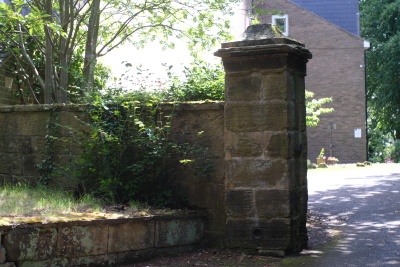
EH listing of Glebelands Lodge reads “Early C19 before 1827” Conzen says 1774-1827. Croft House appears on 1827 OS map. Inscription in St M church reads “Robert Patterson of Croft House, Alnwick, who died April, 1807, aged 44 years.”. John Brown Patterson was born at Alnwick, in the county of Northumberland, on the 29th day of January 1804. His father, Mr Robert Patterson of Croft House, was a “gentleman of distinguished integrity in all the transactions of life” So presumably c. 1800.
Bought by Duchess as vicarage in 1849 (Tate) still shown as vicarage in postwar OS 6” map (surveyed 1938), on OS 1:25,000 map of 1954. Church sold 1981 but believe it had gone well before that . Until further information obtained, we assume it was demolished around 1965. Later heard demolished in 1970's
Croft House in Alnwick stood behind where the tennis courts in Prudhoe Street are today. In the early part of the 19th century several of the more affluent Alnwick families made this mansion their home. One only needs look at the memorials on the wall of the north aisle in St Michael’s Parish
Church to name the first three families to occupy Croft House - Patterson, Lambert and Kerr.
Croft House was built by Linen Draper Robert Patterson who owned a business in Alnwick marketplace. Robert died in 1807 at the young age of 44 and Croft House passed to his son – also Robert. Tragically Robert junior died on 27th December 1811 as a result of a fall from his
horse on Alnwick Moor. He was only 23 years old and had been married for just over a year. Following his death, Robert’s estate was administered under the direction of The Court of Chancery until October 1819 when the property was sold.
In the intervening years the Lambert family occupied the house. Alnwick Solicitor John Lambert’s address at the time of his marriage to Juliana Mounsey in 1812 is shown as Croft House Alnwick and three of their children, Mary Juliana, Anthony and Cicely were born there between 1813 and 1819.
On 13th October 1819, Croft House was sold to Mr Thomas Kerr, another Alnwick Solicitor, for the price of £1,530 and it is documented that he made considerable improvements to the house during the years he lived there. Thomas died aged 74 in September 1831 and, by the terms of his will, Croft House passed to his business partner, John Leithead, in whose possession it remained until his death in 1847.
In 1832, the year after Thomas Kerr’s death, Croft House was to experience a complete change of use when a Miss Thompson “...moved her Establishment for the Education and Board of Young Ladies from Lucker Hall to Croft House, a mansion near Alnwick”. Miss Thompson’s advertisements indicated that a limited number of day pupils would also be admitted to her educational establishment and that “in order to facilitate the progress of her young ladies in the various branches of fashionable education, able masters and other efficient assistants are engaged”. One of the teachers, also a resident of Croft House, was a Parisian Lady who taught French to the young ladies. The school con‐
tinued until 1836 when Miss Thompson died.
In an 1836 advertisement offering the house to let, Alnwick solicitor John Leithead described the property as comprising a dining room, drawing room, breakfast room, servants’ hall, two kitchens, pantry and dairy on the ground floor and four good bedrooms, a light closet and two servants’ rooms above.
The estate also included a four-stalled stable, coach house, granary, a partly walled garden well-stocked with fruit trees plus two enclosures containing together about three acres of old grass land with a stable and water in each. The house was described as being in a very healthy situation, commanding a beautiful prospect of the adjoining country in all directions and that it was in good order and fit for the accommodation of
a genteel family. The dwelling at the entrance to the estate, which is still occupied today, was described as a neat
lodge, containing two good rooms and other conveniences.
By 1841 Edward Thew, an Alnwick merchant, and his family occupied the house.
In July 1847, under the terms of the late John Leithead’s will, Croft House was advertised as going to public auction, although it was oc‐
cupied at that time by Hugh Moises, a local Justice of the Peace. The property was purchased for £2,080 in 1848 by Charlotte Florentia, Dowager Duchess of Northumberland, with the intention that Croft House be used as a residence for the incumbents of St Paul’s Church, which had recently been built in Percy Street. The church, the building of which had been supported by her husband Hugh, 3rd Duke of Northumberland was opened for worship in 1846 and had provided much needed additional accommodation for the town’s Anglican community but His Grace’s untimely death in February 1847 had been before a vicarage could be built. The John Bull periodical at the time reported on the Duchess’s purchase of ”the beautiful mansion and grounds of Croft House, Alnwick, as a parsonage for St Paul’s Church, to which it adjoins” and likened
her generosity to the benevolence of the late Duke.
In 1950 the Vicarage roof was partially re-slated. Half the cost was met by a grant from the Church Commissioners and the other half by a mortgage-loan repayable over ten years from the stipend of the benefice. The intention was that the annual repayments and interest would be paid from the rent of what was described as the “cottage”, which had been created by the division of the vicarage.
Part of the building continued to be rented out until the vicarage was demolished. Sheltered housing, which was opened in 1977, was built on the site.