Site
41, Fenkle Street
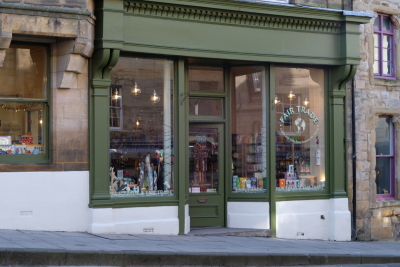
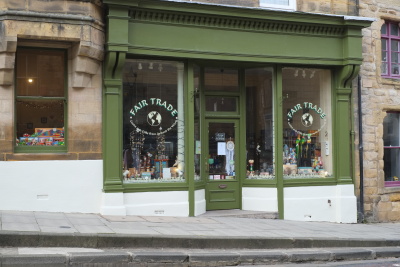
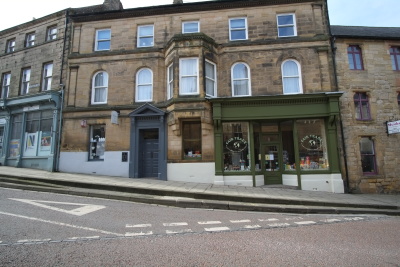
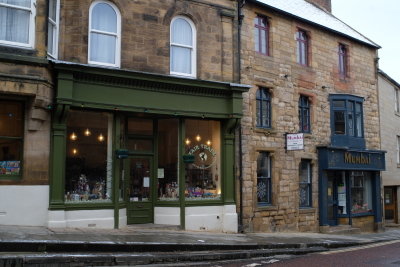
Site of former Half Moon Inn. Tate says that this was referenced in 1671. It appears on Wood's map in 1827 and in various directories: Pigot: 1828, Slater: 1855, Post Office 1858. It closed some time between 1871 and 1891 (Morpeth Herald article).
John White moved out in May 1869 to take over the Angel. John Thew took over ,with the intention of continuing the business of the Half Moon, while carrying out his own trade as a butcher. He was still the landlord in 1871, when some militiamen were accused of stealing his watch.
Some directories include it in Narrowgate, some in Fenkle Street.
From Alnwick Mercury, Jan 1885: "At last, about three years ago, after passing from Mr Baird to Major Browne, the block was purchased by our esteemed fellow-townsman, Mr Newbigin. The site of the Half-Moon Inn, with its small, low-ceilinged rooms, its stables, cow byres, and pigstyes, was ultimately cleared, and on the ground the handsome, lofty, and commodious building we now see was erected. This consists of a spacious dwelling-house, a chemist’s shop, a laboratory for analytical researches, a consulting office, capacious well-lighted cellars for storage purposes ; and in the rear is the large aerated water manufactory, with a granary over it, once the malt bam and malt kiln. The factory within the last few weeks has been considerably increased in size by means of underpinning, when many loads of gravel, forming the bankside on which this part of the town is built, were removed. We must mention that a copy of the Alnwick Gazette” was placed in a bottle below the comer of the new cemented floor of this new work. The adjoining house, believed to be the residence of Mr Richard Strother, the apothecary, in 1724, has been transformed into a confectioner’s shop (Miss Purvis’s), and Mr F. R. Wilson’s offices. An unsightly cellar flap projecting upon the flagging, and flight of stone steps, have been done away with in the course of these improvements, to the general comfort of pedestrians. We must add Mr John Whinham was the contractor for the admirable mason’s work; Mr William Steel, Felton, was the carpenter and joiner; Mr G. Picard, jun., was the plasterer ; Mr George Thompson was the plumber ; Messrs Thompson & Wright were the slaters ; and Messrs A. Robertson and Son were the painters. Messrs Thomas Robertson & Sons executed the fittings. The designs and superintendence of these works, which form such important improvement to the appearance of this part of the town, were entrusted by Mr Newbigin to Mr F. R. Wilson, architect, Alnwick".
From Morpeth Herald 17 June 1905
DEATH OF MR. J. L. NEWBIGIN, OF ALNWICK. We regret to announce the death of Mr. James Lesslie Newbigin which occurred at his residence. Green Bat House, on Sunday morning. Though it was noticed that Mr. Newbigin was failing in health for the last twelve months, that his usually firm and vigorous step was halting, yet had only been confined to bed for a few weeks. was one of the oldest and most respected tradesmen of tho town, admired and esteemed by everyone, and as a public man, who took a very ardent interest in the life and welfare of the town, he will greatly missed. Mr. Newbigin was a native of Blaydon-on-Tyne, and was educated at Newcastle, where also served his apprenticeship for a chemist and druggist with Mr. Joseph Fairs, and was a successful student at tlie Newcastle Col logo "of Medicine. In 1856 Mr. Newbigin secured the old established chemist's business in Alnwick, carried on by Mr. Robert Swan, and which had continued very successfully ever since. In 1880 Mr. Newbigin was first elected a member of the Alnwick and Canongate Local Board of Health, and took great interest in its business, especially in the more important questions of water supply and sewage disposal, involving considerable cost to the town. His knowledge and experience proved of great value, and were deservedly appreciated by the members. He was elceted chairman of the Urban District Council in 1900, and continued a member until the last election, when, feeling himself inadequate for the responsibility, did not seek re-election. About thirty years ago, Mr. Newbigin purchased the property opposite to liis chemists's shop, and built thereon the present commodious business premises on the site of the ancient hostelry known as the Half Moon Inn. Adjoining was the house occupied by John Catnach. father of the celebrated printer of the Seven Dials, which he transformed into a substantial dwellinghouse, and further enhanced the value the premises now tenanted Mr. R. Purvis, confectioner, by adding well-fitted cafe rooms thereto. At the rear these buildings. Mr. Newbigin had his manufactory for aerated waters, the excellence of which were well known the district. Mr. Newbigin was a member of the Berwickshire Naturalists' Club, and was often present at their field days. Ho was a member of the Committee of Management and a Governor of the Alnwick Infirmary, a trustee of the Alnwick Savings Bank, and was one of the first move the establishment of a soup kitchen when such was required. took great interest in educational work the town, and was identified with tho committees and the science and art classes. He had long connection with the Alnwick Infirmary, and in other ways he was associated with the social life of Alnwick, and his presence and services were always greatly esteemed. He was manager of Clayport Presbyterian Church. Mr. Newbigin has left a widow and a grown-up family of talented sons and daughters. One of his daughters, Miss Marian Newbigin, holds tho degree of Doctor of Science in London, and is the authoress of some well-known scientific works; another daughter has obtained the degree M.A., whilst his sons hold responsible positions in important business houses.