Site
23, Clayport Street
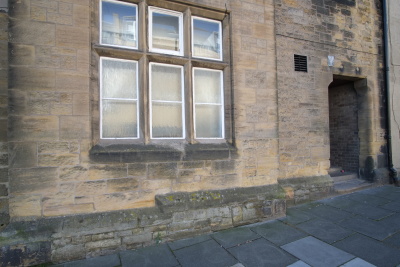
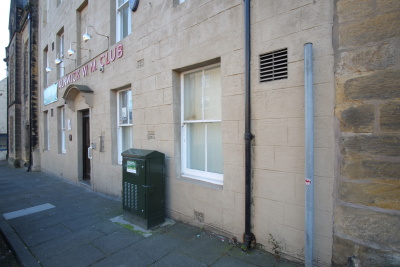
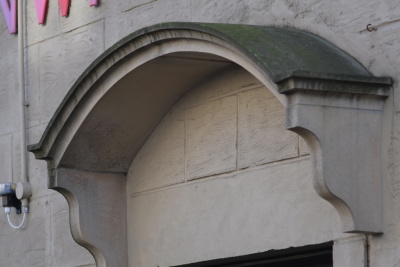
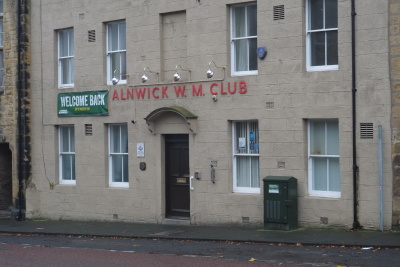
CLAYPORT STREET 1. 5330 (South Side) No 23 NU 1813 SW 4/43 II 2. C18. Very plain ashlar building. Three storeys and 5 windows. Slate roof. Ashlar chimney to right. Late glazed sash windows, one blind over central doorway which has a good bracketed segmental stone hood.
Alnwick Mercury - Saturday 15 February 1873: The public baths and wash-houses combined with a Working Man's Club, which the Duke of Northumberland is erecting in Clayport Street, are still making progress, but the plan of them has been greatly enlarged and the additional space necessary for this purpose has been secured the purchase of the adjoining premises belonging to the late Mr Joseph Appleby, skinner. The details of that part of the building appropriated to the purpose of baths and wash-houses will be as follows. There will be thirteen baths on the ground-floor, eight of them for males and five for females; and a swimming bath will be constructed behind. The spacious court in the rear of the building will contain thirty washing troughs and a drying room. The latter will be heated by steam means of an engine and boiler and from this source also the whole place will be supplied amply with hot water. Then, as regards the Working Man's Club, to which the recently purchased premises will be devoted, the smoking room, entrance hall, and dining room, will be on the ground-floor, and the club room and billiard room upstairs. It estimated that the expenditure incurred by his Grace in carrying out this extensive scheme will be between £6,000 and £7,000 when the buildings are finished. Mr Geo. Armstiong, of our town, will be the builder, and the whole will be carried out under the personal superintendence of Reavell, his Grace's architect, to whom the merit of the handsome design for the front, and the adapting the different parts of the building to the peculiar shape of the ground is justly due. The above facts, which were already pretty well known, but which appeared to call for mention in this place, speak for themselves and show that our Duke is a real philanthropist.
Morpeth Herald, Sat. 1 Jan 1876: On Monday evening, the Working Men's Club, which has been erected in Clayport. Alnwick, at the expense of his Grace the Duke of Northumberland, and presented as a free gift to the town, was opened by a public meeting, which was held in the Town Hall, Alnwick, under the presidency of the Duke of Northumberland, the patron of the club. The club consists of the following rooms. On the ground floor are the dining room, smoking room, and conversation room, bar, and kitchen, the latter fitted with every appliance for cooking. There are also good cellars, pantries, and every accommodation required for the use of the members. the first floor is spacious reading room, 32 feet long by 17 feet broad, and 13 feet in height. In connection with the reading room is a lavatory; and on the same floor there is a large bagatelle room, and also a committee room, with bed rooms, and other rooms behind for the servants. On the second floor are six bedrooms, all neatly furnished by his grace for the use of the manager, his family, and staff. The ventilation of the public rooms has been carefully attended to, and they are well lighted by sunlights. In connection with this building and the baths and washhouses is a large soup kitchen, fitted up with two large pots, the soup being boiled from the bath boilers. The building has been planned and designed by Mr. G. Reavell, resident architect to his Grace, and the whele of the works have been carried out, under Mr. Reavell's superintendence, by the following tradesmen Messrs. Armstrong Brothers, masons; Mr. H. Hunter, joiner; Mr. G. Pickard, plasterer; Mr. T. Rutherford, slater; Messrs. Adam Robertson and Son, painters aad glaziers; Messrs. Wilkin and Dickman, plumbers and smiths; and the furnishing by Messrs. Thomas Robertson and Son.
Bhy the time the public baths and wash houses were constructed on Clayport in 1874 a piped water supply to the town had been in place for about 20 years, and was beginning to prove inadequate to support increased demand. On 10 June 1876, Alnwick Board of Health noted that the Assistant Surveyor was receiving complaints from the higher parts of town that their water supply was failing on Sunday Mornings because the baths were filling the large pool ready for use on Monday. There was a fear that this might result in kitchen boilers exploding.